A Practical Guide to Setting a clear scope for sourcing support
A clear scope names the work, evidence, decisions, fees, and handoffs expected from a sourcing provider. It lets both sides see what is included, what depends on buyer input, and what needs a separate specialist before an order is underway.
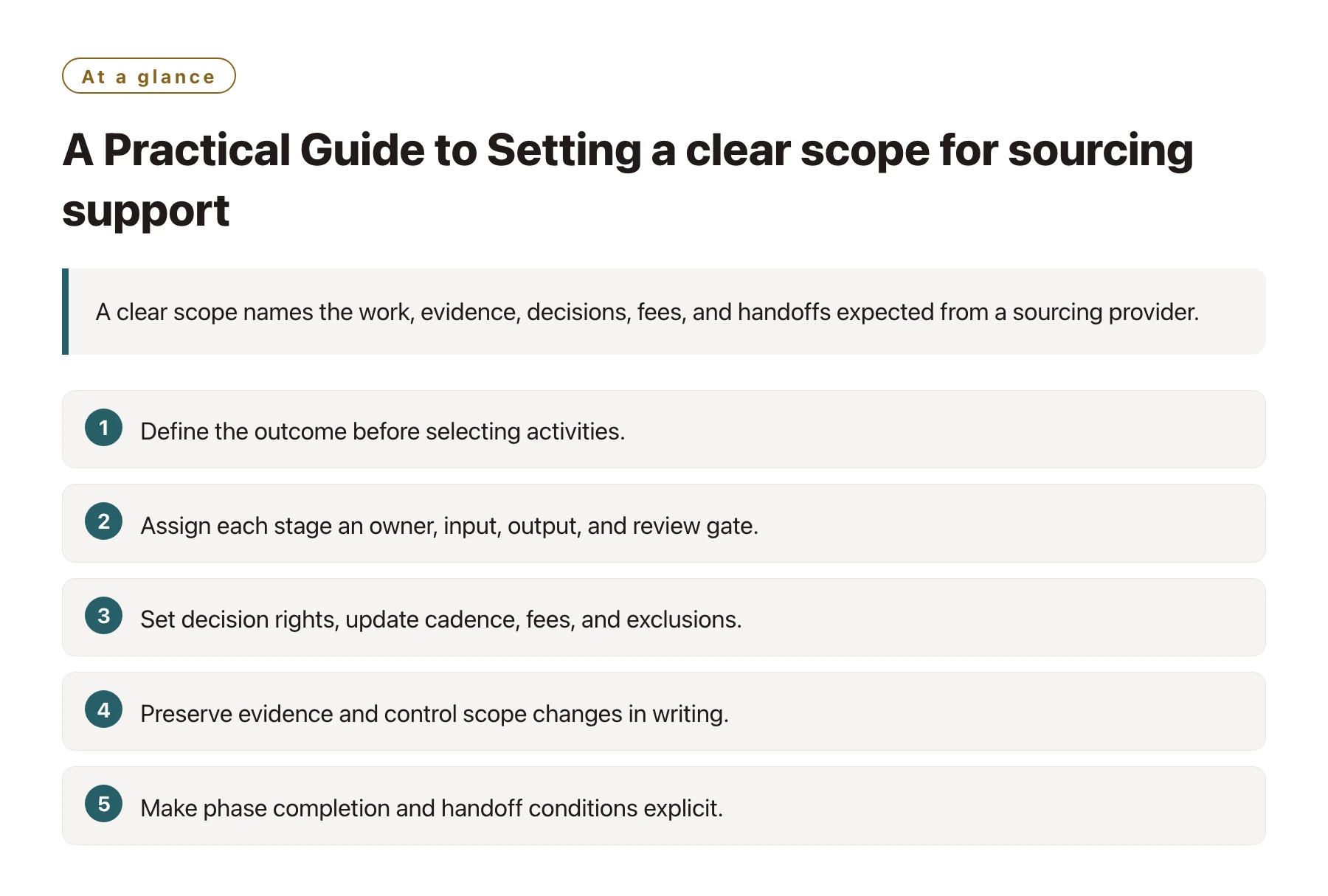
Key takeaways
- Define the outcome before selecting activities.
- Assign each stage an owner, input, output, and review gate.
- Set decision rights, update cadence, fees, and exclusions.
- Preserve evidence and control scope changes in writing.
- Make phase completion and handoff conditions explicit.
A detailed scope reduces ambiguity without trying to predict every event. It gives the buyer and provider a shared operating plan and a clear route for handling changes.
1. Start with an outcome, not a service label
“Sourcing support” can mean anything from finding factories to managing production exceptions. Write the business outcome first: for example, receive three comparable supplier offers, coordinate an approved sample, or maintain weekly production evidence. A concrete result makes it possible to decide whether a proposed service is complete and whether the fee is proportionate.
Describe the purchase context in enough detail for a provider to estimate the work: product family, destination market, intended use, order range, timing, current suppliers, and known constraints. State which details are provisional. Separate the immediate task from possible later phases so a small discovery project does not quietly become an open-ended commitment.
2. Map the work into stages
Break the assignment into supplier discovery, screening, RFQ coordination, quotation review, sample handling, production follow-up, inspection coordination, and shipping handoff as relevant. Each stage should have an owner, input, output, due date, and approval gate. Avoid combining several activities under a label such as “factory management” without explaining how they will be performed.
For each stage, identify dependencies. Quotation comparison needs a stable specification; an inspection needs an agreed method and sample plan; booking shipment needs verified packing information. A simple sequence helps the provider flag missing inputs before the calendar starts and clarifies which delays are under the buyer’s control.
3. Define deliverables that can be reviewed
Describe the form and minimum content of each output. A supplier shortlist might show legal or trading identity, location, product fit, evidence gathered, open questions, and screening date. A quotation comparison should show currency, assumptions, options, payment, lead time, delivery basis, exclusions, and deviations. A production update might include milestone status, dated evidence, blockers, and owner.
Set acceptance criteria for the deliverable, not just a promise to “support” the task. State how quickly the buyer will review it, how many correction rounds are included, and what happens if evidence is unavailable. These details create a practical completion test without requiring the provider to guarantee outcomes outside its control.
4. Allocate decisions and authority
List decisions that remain with the buyer: supplier appointment, technical specification, price acceptance, sample approval, production release, regulatory interpretation, and final acceptance. If the provider may negotiate or communicate commitments, define the exact limits, approved language, and escalation threshold. Do not rely on informal assumptions about who can authorize a purchase or change.
Name a primary contact and an alternate on each side. Agree which communication channel constitutes an approval and how urgent decisions are recorded. If a call resolves a point, send a short written confirmation into the project record. A clear authority map prevents a routine status conversation from being mistaken for approval of a cost, deviation, or shipment.
5. Set a workable cadence and service levels
Choose update frequency based on activity and risk. During supplier discovery, a weekly summary may be adequate; during a time-critical production run, the buyer may need updates at defined milestones or when an exception occurs. Specify working hours, time zone, expected acknowledgement time, escalation contacts, and what counts as an urgent issue.
Avoid service levels that cannot be measured. Replace “quick responses” with an acknowledgement target and a separate resolution or next-update expectation. Record holidays, factory shutdown periods, and buyer review windows that affect the schedule. Build a change route for missed milestones instead of assuming that every delay can be recovered through more frequent messages.
6. Make fees, expenses, and exclusions visible
Ask for a fee schedule tied to activities or project phases. Identify whether charges are fixed, hourly, per supplier, per visit, or commission-based, and state what event triggers payment. Clarify translation, travel, sample, courier, laboratory, inspection, storage, banking, and logistics expenses. Set an approval threshold for additional costs and require an estimate before work begins.
Write exclusions in plain language: technical design, independent laboratory testing, certification, customs brokerage, legal advice, or freight contract negotiation may sit outside the scope. A provider may arrange a third party without taking responsibility for that party’s professional conclusion. The buyer should assign qualified owners for specialized decisions and budget those services separately.
7. Decide what evidence and records are required
Specify records for each stage: supplier identity and claims, quotation revisions, sample photographs and test results, meeting notes, production evidence, inspection findings, change approvals, and shipping documents. Decide where files are stored, naming and version rules, access permissions, retention period, and how records are returned at project end.
Require the provider to distinguish what it observed from what a supplier stated and what remains unverified. Date evidence and connect it to a requirement or milestone. When a photo or document cannot establish a critical fact, describe the next verification method. The goal is a useful decision trail, not a larger folder of material without context.
8. Address confidentiality and supplier relationships
List information the provider may share with factories and information it must keep restricted, such as customer identity, drawings, target price, formulas, or launch dates. Identify permitted subcontractors and require approval before information is passed to another party. Set practical security expectations for file access and for handling account credentials or payment instructions. The U.S. Department of Commerce recommends due diligence when evaluating foreign business partners; buyers can align the depth of those checks with the relationship and transaction. [1]
Disclose commissions, referral payments, rebates, ownership interests, and other supplier relationships that could affect recommendations. Define how a new relationship is reported and what the buyer may do if a conflict arises. Transparent compensation does not remove every risk, but it lets both sides establish review and approval controls before a supplier is selected.
9. Define change control and exception handling
Specify how scope changes are proposed, priced, approved, and scheduled. A new product variant, second factory, revised material, extra inspection, or rush request may materially alter workload. Ask the provider to document the effect on fees and timing and wait for the designated buyer to approve before proceeding, except for agreed emergency steps.
For a supplier deviation, record requirement, proposed change, reason, cost and schedule impact, evidence, decision owner, and disposition. Set escalation thresholds for safety, compliance, quality, and shipment issues. Keep the original requirement and approval so later teams can tell what changed and why.
10. Close the scope with a handoff
Define completion conditions for each phase, unresolved items at close, and the final handoff package. If work continues into production, specify whether a phase acceptance means the whole purchase is accepted; usually it should only close the named service deliverable. Keep product acceptance and commercial release decisions with the responsible buyer role.
Review the scope with all participants before launch and again after the first milestone. Buyers evaluating JS Sourcing can use this framework to compare stated services, outputs, fees, and decision boundaries with the actual project brief. Confirm the current scope directly, then attach the agreed deliverables and change process to the working agreement.
Sources
Frequently asked questions
What belongs in a sourcing support scope?
List each activity, deliverable, owner, due date, fee basis, buyer input, approval gate, and exclusion.
Should the provider be responsible for supplier quality?
Define the exact checks and evidence it will coordinate. Assign product acceptance and technical decisions to qualified buyer owners.
How should a scope change be approved?
Require a written description of added work, cost, and schedule impact, then approval from a named buyer authority.
How often should the provider send updates?
Set cadence by project stage and risk, with separate expectations for urgent exception alerts and routine status reports.