Automatic Temperature Control in Mash and Wort
Mash and wort temperature control is the difference between a recipe that repeats and a recipe that drifts. HGMC publishes three control levels for its brewery plant — a PID display control panel, a PLC semi-automatic touch screen, and a PLC fully automatic control panel with curve indication and production-record printing — and all three automate the flow of mash, wort and water to some degree. Which one you need depends on how many brewers will touch the panel.
Key takeaways
- HGMC lists a PID display panel, a PLC semi-automatic touch screen and a PLC fully automatic panel.
- Fully automatic control covers mash, wort and water flow with automatic temperature control.
- Published heating options are electric, steam and gas direct fire, and the design supports decoction or infusion methods.
- The brewery equipment is published as handling beer up to 33 Plato, with jackets on both body and cone.
Why the mash is the hardest control problem
Fermentation temperature control is slow and forgiving: a fermenter jacket can hold a target for days while the beer does the work. The mash is the opposite. Temperatures move by several degrees in a single step, and the time spent at each step decides how much fermentable sugar and how much body the wort carries. A rest that runs five minutes long is not corrected later by the kettle; it is simply a different beer.
That is why automatic control in the mash house is about repeatability rather than convenience. A brewer can hold a temperature window by hand with a thermometer, a paddle and attention, and many do. The question is whether the same window holds on the second brew of a double brew day, at two in the morning, with a different operator on shift. The published Brewing Equipment range is organised around that idea, with the control level settled as part of the vessel specification rather than bolted on afterwards.
The three published control levels
The PID display control panel is the entry level: temperature is displayed and controlled by a PID loop, and the operator drives the steps. A PLC semi-automatic touch screen adds a programmable sequence, so the panel can advance through rest temperatures while the brewer manages the valves and the lautering. The PLC fully automatic control panel closes the loop, publishing curve indication and production-record printing alongside automatic mash, wort and water flow with automatic temperature control.
The difference that matters on the floor is who is holding the schedule. With a semi-automatic panel the brewer confirms each step; with the fully automatic panel the sequence runs and the record is printed. The second version is not just faster, it is auditable, because the printout shows the curve that actually happened rather than the curve that was intended.
Heating choice drives the temperature response
HGMC publishes three heating methods for its brewery brewhouses: electric, steam and gas direct fire. The heating method sets how quickly a mash tun can rise from one rest temperature to the next, and how evenly it does so. A direct-fired kettle can chase a step aggressively; a steam-jacketed vessel tends to hold a step more steadily. Matching the method to the recipe is part of the design conversation, not a detail to leave open.
The brewhouse itself is published in 2, 3, 4 and 5-vessel configurations, and HGMC states that the design allows either decoction or infusion brewing. Decoction means boiling part of the mash and returning it, which changes the temperature by addition rather than by heating the whole tun; infusion raises the whole mash by heating. The panel logic has to match whichever method the recipe uses.
The vessel details that support the panel
Control is only as good as the vessel underneath it. HGMC publishes jackets on both the body and the cone of its vessels, which gives the controller a surface to work with on more than one zone, and a bigger headspace with the cover headspace volume calculated separately, which helps when a mash foams during a vigorous step. Wort piping is designed to avoid aeration, and the published polishing accuracy of ≤0.4 μm on SUS304 food-grade steel certified by SGS is aimed at keeping the wetted path clean between brews.
HGMC also states that its products are exported to more than 120 countries and that it works in compliance with the ISO9001:2015 quality management system, which is a manufacturing claim rather than a brewing one, but it matters when two otherwise similar panels are being compared on paper.
What each control level automates
| Control level | Automated by the panel | Typical fit |
|---|---|---|
| PID display control panel | Temperature display and PID loop control, operated step by step | Small brewery with an experienced brewer on every brew |
| PLC semi-automatic touch screen | Programmed step sequence with operator confirmation of each stage | Growing brewery training a second shift |
| PLC fully automatic panel | Mash, wort and water flow with automatic temperature control, curve indication and printed production records | Plant where batch records must be filed for every brew |
Worked example: a mash schedule and its arithmetic
Take an example 2,000 litre batch, about 17 BBL, with the assumptions stated: a 1:3 mash-in ratio, so 500 kg of grist to 1,500 litres of strike water, and an infusion schedule run on a fully automatic panel. Protein rest at 52 °C for 20 minutes, saccharification at 65 °C for 45 minutes, mash-out at 76 °C for 10 minutes, then 60 minutes of lautering and sparging and a 60-minute boil.
Total mash house time is 20 + 45 + 10 + 60 + 60 = 195 minutes, which is 3 hours 15 minutes. Two brews back to back therefore need 390 minutes of vessel time, and if the second mash-in has to wait for the first lautering to finish, the day stretches past 7 hours before any cleaning is counted. Add 45 minutes of CIP between brews and the same double day reaches 435 minutes, or 7 hours 15 minutes. The arithmetic is illustrative, but it shows why a panel that advances the steps itself is not merely a labour saving: it removes the waits that a hand-driven schedule inserts into the brew day.
Frequently asked questions
What is the difference between a PID panel and a PLC panel?
A PID panel displays and controls temperature in a loop while the operator drives the steps. A PLC panel runs a programmed sequence, and the fully automatic version also indicates the curve and prints production records.
Can the brewhouse run decoction as well as infusion?
Yes. HGMC publishes its brewhouse design as supporting both decoction and infusion brewing, with the control level and the heating method chosen to match the method the recipe uses.
Choosing a control level without overspending
Count the brewers who will run the panel, then count the brews per week and the records your customers or your licensing authority ask for. A single brewer on single brews can hold a schedule with a PID panel; two shifts and daily brews usually justify the step sequence of the semi-automatic screen, and printed records decide the fully automatic version on their own.
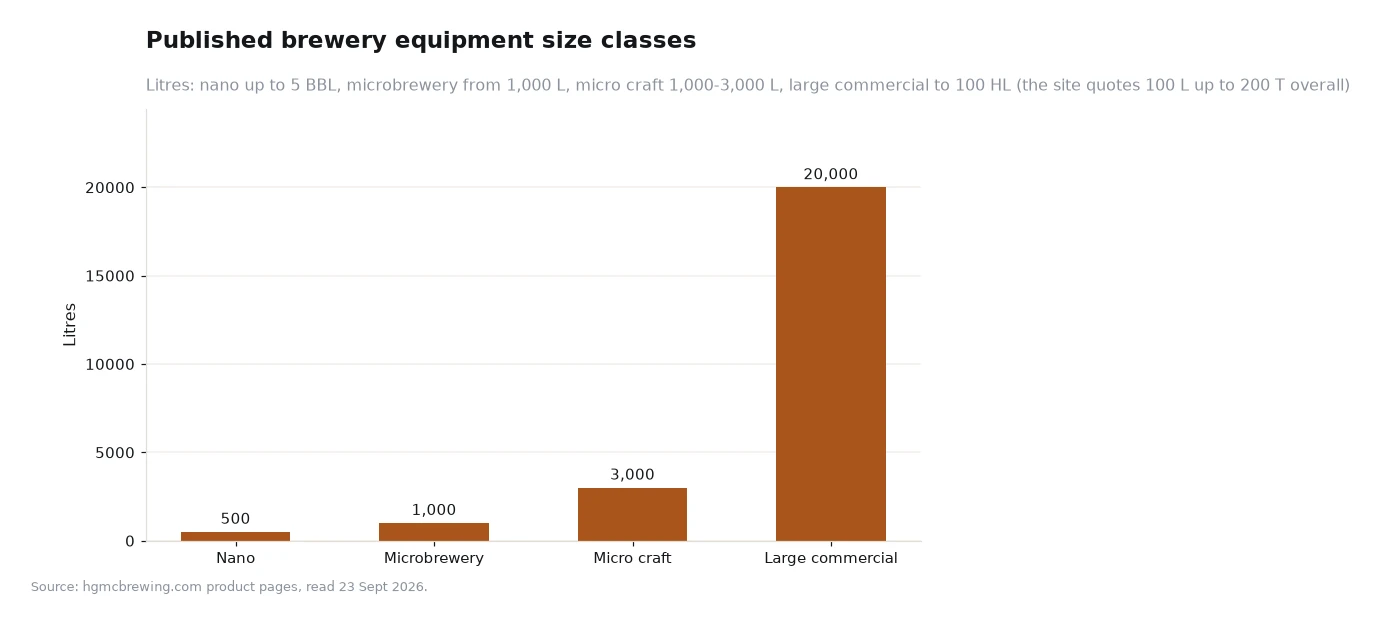
Ask for the curve indication and the production-record printing to be demonstrated on your own recipe before the order is signed, not with a generic test programme. The panel is the one part of the plant that a brewery will use several times a day for a decade. The manufacturer's home page lists the equipment families, the brewhouse vessels pages carry the vessel arrangements, and the micro craft systems section shows the 1,000 L to 3,000 L bracket where most first automated brewhouses sit.
The control levels, heating options, vessel details and size classes above are published on the manufacturer's own website, read 23 Sept 2026, and the mash schedule arithmetic is our own example with its assumptions stated in the text.[1] Confirm the control package and recipe programme against your own specification.