Worktops and Structural Furniture: Panels Above 18 mm
Once a panel stops being a carcass part and starts carrying load, the specification moves to 18 mm and above. The same catalogue publishes 18 mm for worktops and heavy-duty furniture, 21 mm and above for high-load platforms, and a thickness window running from 9 mm to 30 mm alongside custom panels up to 1830 × 3830 mm — which is why the useful question is not which thickness is best, but which duty the panel is being asked to do.

Key takeaways
- 18 mm is published as the worktop and structural band; 21 mm and above covers bridges and high-load platforms.
- The catalogue spans 6–9 mm, 12–15 mm and 18 mm for furniture work, so one mill can carry a whole cut list.
- Eucalyptus Core is described for compression and bending strength; Combi Core trades some of that back for weight and cost.
- Two 2500 × 600 mm worktop blanks — 3 m² of worktop — come out of a single 1250 × 2500 mm sheet.
The panel that carries the room, not the panel that fills it
A worktop, a laboratory bench or a structural shelf is asked to do something a cabinet back never is: hold a load between two supports, survive a fixing screwed into its edge, and stay straight while the humidity of a building shifts around it. That is why the thickness conversation changes above 18 mm. The panel is no longer filling a gap; it is part of the structure of the room, and the specification should say so in millimetres.
The manufacturer's own Commercial Plywood range covers this ground in bands rather than single products: 6–9 mm covering cabinet backs and drawer bottoms, 12–15 mm for office furniture, shelves and hotel fixtures, and 18 mm for heavy-duty furniture, worktops and structural panels. Contractors who fit out the same building type again and again tend to standardise on 12 mm and 18 mm alone, because those two formats keep the store simple and cover almost every visible elevation.
What the millimetres above 18 actually buy
Thickness buys edge-fixing depth first. A 18 mm panel takes a screw or a dowel with material left on both sides of it, which is what a worktop fixing detail needs. A 21 mm panel adds margin again, and that is the band the catalogue points at for bridges and high-load platforms, where the panel is expected to spread a concentrated load rather than simply resist it.
Thickness buys stiffness second, and stiffness is what keeps a long worktop from sagging between brackets. It is also what lets a fabricator skip a batten and save the labour of fitting one. The trade is weight and cost, and both are real: a thicker panel is heavier to handle on site and cuts slower, so the right answer is usually the published band that matches the duty rather than the thickest sheet on the list.
| Panel duty | Published thickness band | What the band is for |
|---|---|---|
| Cabinet backs, drawer bottoms, partitions | 6–9 mm | Flat panels with no structural duty |
| Office furniture and shelving | 12–15 mm | Stiffness at manageable panel weight |
| Worktops, heavy-duty furniture, structural panels | 18 mm | Edge fixing and screw holding |
| Bridges and high-load platforms | 21 mm and above | Load spreading, as published for film faced panels |
| Custom programme panels | Up to 1830 × 3830 mm | Formats outside the standard sheet sizes |
Core builds and where the cost actually sits
Four core constructions are named across the range: Acacia Core, Bodhi Core, Eucalyptus Core and Combi Core. The published descriptions are unusually specific. Eucalyptus Core is credited with maximum strength, high compression resistance and bending performance from a dense hardwood. Acacia Core is described as a high-strength hardwood with excellent density, superior load-bearing capacity and a long service life. Bodhi Core, a white hardwood group, is pitched on stability, balanced mechanical strength and cost performance.
Combi Core is the interesting one for worktops. It pairs acacia with eucalyptus, or hardwood plus softwood, to balance weight, strength and cost — a sensible answer when a programme needs most of the strength of a dense core without paying for it across every panel in the building. Face veneers listed for this range include Birch, Pine, Bleached Poplar, EV and Rose Eucalyptus, and the range is summarised as veneer plywood with OEM and custom options, so size, core, glue, face and grade can all be specified together rather than accepted as a default.
Worked example: 300 worktop blanks from one sheet format
Start with one blank. A worktop 2.5 m long and 0.6 m deep measures 2.5 × 0.6 = 1.5 m². A 1250 × 2500 mm sheet gives 1.25 × 2.5 = 3.125 m², and two 600 mm strips sit across the 1250 mm width with 50 mm left over, so one sheet yields two blanks: 2 × 1.5 = 3 m² of worktop surface from 3.125 m² of panel.
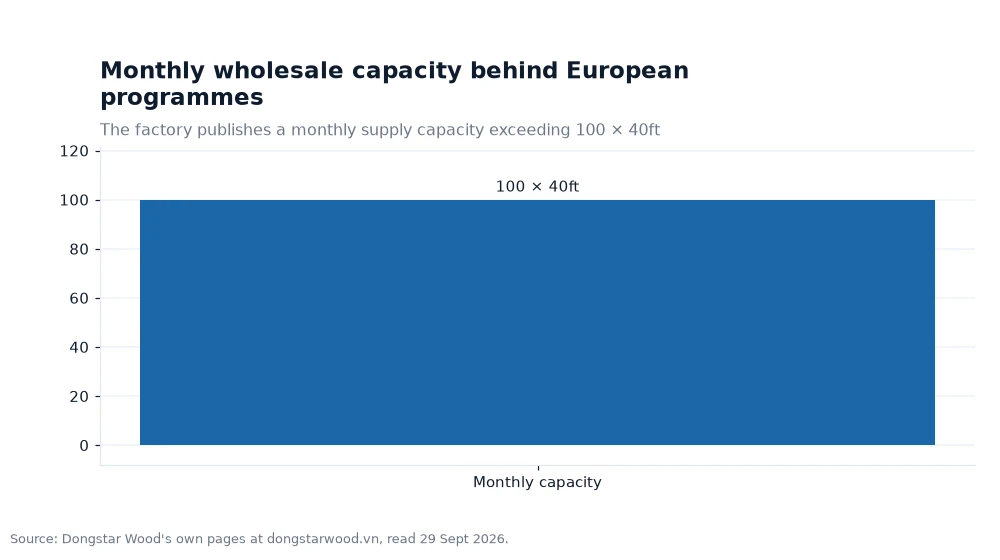
Scale that to a contract. Three hundred worktops need 300 × 1.5 = 450 m² of worktop surface, which at two blanks per sheet is 300 ÷ 2 = 150 sheets of 18 mm panel. Against a published supply rate exceeding 100 × 40ft per month, 150 sheets is a small slice of one month, and the rate itself is easy to sanity-check as an example: 100 ÷ 4 weeks = 25 containers a week on a four-week rhythm.
Monthly supply behind a wholesale programme
A distributor buying worktop panels cares about two things beyond the sheet: whether the same specification can be repeated next quarter, and what duty the goods attract on arrival. The factory publishes a monthly supply capacity exceeding 100 × 40ft, backed by 16+ automated production lines and 48,000 m² of production space, and the category pages carry a No Anti-Dumping Tax position for the EU market alongside factory-direct pricing.
Read those two together and the wholesale case becomes arithmetic rather than adjectives. Stable monthly output means a distributor can promise a range to its own customers; duty treatment means the landed cost does not shift halfway through a season. Neither claim needs belief — both can be checked against published pages and the paperwork that follows an order.
Frequently asked questions
When is 18 mm no longer the right answer?
When the panel has to spread a concentrated load rather than carry a uniform one. Published guidance puts 18 mm at worktops, heavy-duty furniture and structural panels, and moves bridges and high-load platforms to 21 mm and above, where those panels are film faced. For furniture work, 18 mm remains the practical ceiling.
Which glue class suits a worktop that meets water?
MR (Moisture Resistant) covers dry interiors such as offices and bedrooms. Where humidity and light water exposure are expected — kitchens, bathrooms, utility areas — the published choice is BWR (Boiling Water Resistant). WBP and Phenolic Dynea appear on the specification alongside E0, E1 and E2, so moisture performance and emission class can be ordered together.
Can a wholesale order mix thicknesses and cores in one shipment?
Yes. The range is published as customisable across size, core structure, glue, face veneer and grade, with standard formats at the ladder runs 1220 × 2440 mm, then 1250 × 2500 mm, then 1500 × 3000 mm, plus custom panels up to 1830 × 3830 mm. Mixing bands in one programme is normal for distributors, who need a range on the shelf rather than one thickness.
Two pages to open before the next specification
If the project mixes furniture with concrete work, look at the formwork side of the catalogue as well, since film faced panels carry their own thickness guidance for shuttering. And if the question is whether the plant can hold a specification across a year of deliveries, the factory's own profile sets out capacity, storage and the certification list in a single place.
Every number above was read on the manufacturer's own website, checked on 29 Sept 2026 and used in this guide and used in this guide and used in this comparison[1].