Evaluating Suppliers for a Wholesale Home Fragrance Project
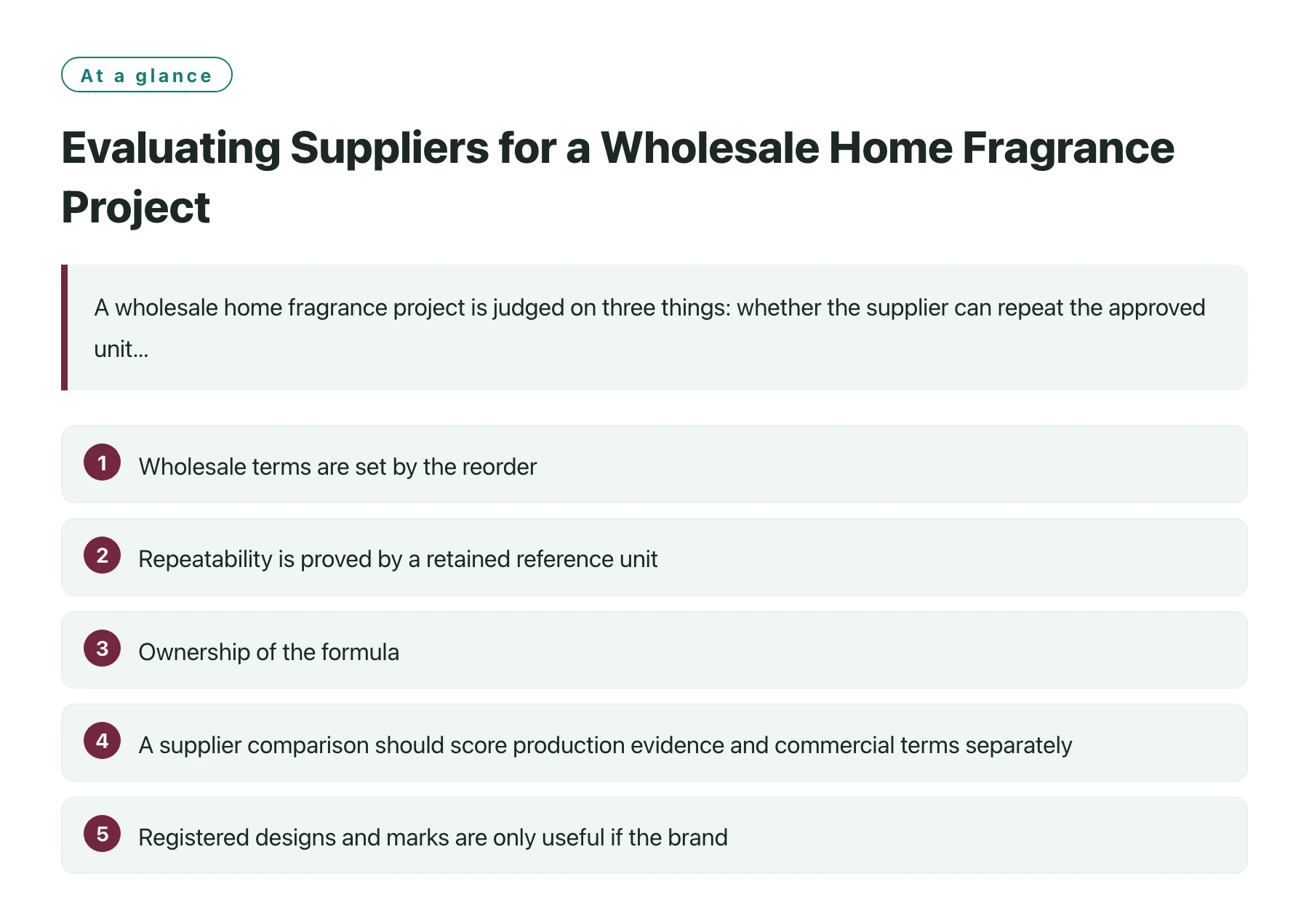
A wholesale home fragrance project is judged on three things: whether the supplier can repeat the approved unit, whether the commercial terms survive a reorder, and whether the brand can leave with its specification intact. Price decides none of those. Buyers who build their supplier comparison around those three questions end up with a partner they can scale with; buyers who compare only quotations end up re-tendering within a year.
Key takeaways
- Wholesale terms are set by the reorder, not the first order, so minimum quantities and price tiers should be agreed before the first production run.
- Repeatability is proved by a retained reference unit, a fill tolerance and a test record, not by a sample that was made by hand.
- Ownership of the formula, the tools and the artwork files has to be established while the relationship is new.
- A supplier comparison should score production evidence and commercial terms separately, because a low price with weak evidence is not a cheaper option.
- Registered designs and marks are only useful if the brand, not the supplier, holds them [1].
Wholesale buyers usually come to a home fragrance manufacturer with a range rather than a single product: three scents, two formats, one carton structure. That shape changes the evaluation, because the decision is not only about whether the supplier can make one thing but whether it can hold a range together across seasons and reorders.
The scorecard below is built for that situation. It is deliberately boring: the questions that matter in wholesale are not clever, they are just frequently skipped.
Start with what you will need in year two
A first wholesale order is small enough to forgive a lot. The second and third orders are where weak arrangements show: a minimum quantity that only made sense at launch, a price tier that stepped up unexpectedly, a carton dieline that only one printer can run, a scent that was reformulated because a material changed and nobody kept the specification.
It is therefore worth evaluating a supplier against the year-two version of the project before placing the first order. Ask what the reorder price, the reorder minimum and the reorder lead time would be, and ask what would change them. Suppliers who answer with a document are usually the ones who have done this many times.
For buyers who are new to a wholesale format, it helps to read how these projects are normally structured before writing the request. Xuelei's guide covers the wholesale custom fragrance workflow from brief to repeat order, and it is a useful reference to compare a supplier's answers against.
A wholesale evaluation scorecard
| Area | What to ask | Evidence that counts | Red flag |
|---|---|---|---|
| Repeatability | How is the approved unit defined? | Retained reference, fill tolerance, batch record | Approval by photograph |
| Reorder terms | Price, minimum and lead time at reorder | Written tier table with conditions | Price valid only for the first order |
| Range consistency | Will all scents use the same base and vessel? | Shared material list across the range | Each scent quoted on a different substrate |
| Ownership | Who holds the formula, mould and artwork? | Named in the agreement, not implied | Supplier retains everything by default |
| Testing and documents | Which tests are routine, which are billed? | A list with scope and provider | A certificate offered instead of a test scope |
| Capacity signals | How does the schedule look at your peak? | Named production window in writing | Vague reassurance about busy periods |
Score the six rows independently, then look at the pattern. A supplier with one weak row is manageable; a supplier with three is a project risk that no discount compensates for.
The ownership questions buyers ask too late
Wholesale relationships are long, and the things a brand accumulates inside them are not just products. There is a fragrance specification, often a mould or a tooling insert, a carton dieline and a set of artwork files. If those belong to the supplier, the brand's practical options at the end of the relationship are limited to continuing or restarting.
Industrial designs and marks can be registered through national systems or through the international routes administered by WIPO, and registration is only useful when the brand is the holder [1]. That is a commercial arrangement as much as a legal one, and it is far easier to settle before the first order than after a successful season.
Testing arrangements worth writing down
Testing is the second thing that gets settled too late. Some checks sit inside a manufacturer's standard process; others are commissioned externally, with a fee and a lead time. Testing providers publish the scope they cover, from cosmetic safety to household and personal care products [2], and knowing that scope lets a buyer specify the programme instead of accepting whatever was run. The question to ask is simple: which tests are routine, which are billed separately, and who holds the results.
The checks worth doing before signing
Before a contract, the useful checks are procedural rather than technical: walk one batch record from intake to release, confirm the fill tolerance on the line, and ask to see how a complaint is handled after shipment. Xuelei sets out a version of that list in more detail, and it is short enough to work through in a single supplier visit.
An evaluation sequence that respects your own calendar
- Write the range brief onceFormats, scents, fill volumes, carton structure and the volume tier you expect in year one. Send the identical document to every supplier you approach.
- Compare the written answers, not the callsScore the six areas above on paper. Verbal reassurance is not evidence and disappears when the contact changes.
- Ask for the reorder picturePrice, minimum and lead time at the expected year-two volume, in writing, with the conditions that would change them.
- Verify one claim in person or by recordPick the claim that matters most to your product and ask to see the evidence. One verified claim is worth more than five assurances.
- Freeze the specification before the depositCategory, dosage, substrate, fill tolerance, closure, decoration and packaging ownership, signed by both sides.
Wholesale home fragrance projects rarely fail at the sample stage. They fail at the second order, when a term that was never written down meets a volume that was never priced. Spend the first meeting on year two and the later meetings become shorter.
What good suppliers do differently at this stage
The suppliers that handle wholesale well tend to behave in a recognisable way during evaluation. They answer commercial questions with a document, they separate their own scope from anything subcontracted, they volunteer the limits of what they can do, and they are comfortable discussing ownership because they have done so many times before.
That last point is a reasonable filter. A manufacturer that serves a large number of brands, as Xuelei China states it does on its public pages, has to have clear ownership terms, because the alternative would make every client relationship a negotiation. Whether the numbers matter to a particular project is a separate question, but the habit of writing terms down is itself a signal worth weighing.
Sources
- WIPO — World Intellectual Property Organization —— The UN agency for intellectual property; resources on industrial design and patent protection relevant to product and packaging design.
- SGS: Cosmetics, Personal Care & Household Testing —— Testing, inspection and certification services for cosmetics and personal care, including microbiological, stability and safety testing aligned with cosmetics GMP.
Frequently asked questions
What should a wholesale home fragrance agreement cover?
At minimum: the frozen specification, fill tolerance, packaging ownership, price tiers for at least two volumes, reorder lead time, the testing programme and what happens to tools and artwork files if the relationship ends.
Should I use the same supplier for all scents in a range?
Usually yes for consistency of base, vessel and carton, which reduces cost and simplifies approvals. Splitting a range across suppliers can make sense when formats are genuinely different, but it multiplies the documentation work.
How many rounds of samples should a wholesale project expect?
It varies with how specific the brief is. A precise brief with a defined application category, substrate and intensity target usually converges faster than a broad one, because fewer variables are left for the perfumer to guess.
Is a lower unit price worth weaker production evidence?
Rarely at wholesale volumes. The cost of a failed second order — remade stock, missed window, re-approval — is normally larger than the price difference that tempted the decision.
What is the single most useful document to request?
A batch record for a comparable product, walked through from material intake to release, plus the fill tolerance used on that line. It shows both the process and how the supplier documents it.