How to Compare Three RTA Cabinet Quotes
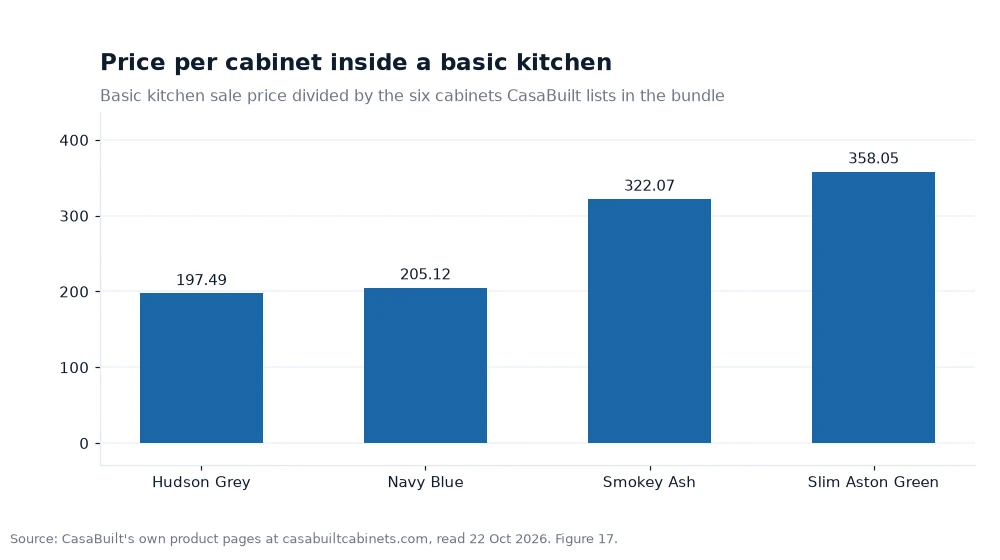
Three quotes for the same kitchen rarely describe the same kitchen, which is why the total at the bottom is the least useful number on the page. The comparable figure is price per cabinet against a fixed list of positions, and CasaBuilt's own catalog shows how far that can move: $197.49 per cabinet in Hudson Grey against $358.05 in Slim Aston Green. Normalize the list first, then read the price.
Key takeaways
- Restate every quote against one cabinet list, with the same widths and the same positions.
- Divide the total by the number of cabinets before comparing, then check what each cabinet is made of.
- Published per-cabinet prices in this catalog run from $197.49 to $358.05 across the basic kitchen.
- A lower total usually means a shorter specification or a smaller list, not a better price.
Fix the list before looking at the totals
Start with a bill of quantities: one row per cabinet position, with the width, the type and the wall it belongs to. Thirty-six inches of base run is one 36-inch cabinet or two 18-inch cabinets, and the two are not interchangeable on price or on function. Build the list once, from the measured room, and send the same list to every supplier.
This is the step buyers skip when they are in a hurry, and it is the step that makes the other two quotes readable. If one supplier quotes 8 cabinets and another quotes 11 for the same wall, the totals describe different levels of storage. Restating both to the same 9 positions takes one email and removes most of the confusion.
CasaBuilt publishes the width ladder openly, so the list can be built to the inch before any quote is requested: base cabinets at 9, 12, 15, 18, 21, 24, 27, 30, 33, 36, 39 and 42 inches, wall cabinets from 9 to 39 inches in 30, 36 and 42 inch heights, and vanities from 12 to 48 inches. A list built from that ladder is a fair test for any supplier, because the positions exist in stock sizes.
Divide by cabinet count, then by the right cabinet
A per-cabinet figure is a blunt instrument, but it is the only figure that survives a difference in order size. Take the published basic kitchen of six cabinets and divide: $1,184.93 becomes $197.49 per cabinet in Hudson Grey, $1,230.69 becomes $205.12 in Navy Blue, $1,932.42 becomes $322.07 in Smokey Ash and $2,148.28 becomes $358.05 in Slim Aston Green.
The averaging hides composition, so use it as a first pass and not as a verdict. A six-cabinet bundle that includes a tall oven cabinet and a vanity is not the same value as six base cabinets, even at the same total. Where the lists differ, compare position by position: base to base, wall to wall, tall to tall.
One more caution. A quote that includes delivery, toe kick, fillers and hardware is not comparable with one that excludes them, and the smaller total is often the one with less inside it. Add every line back in before dividing, or the per-cabinet figure flatters the wrong supplier. Buyers who want a second read on that arithmetic can use the design-to-budget estimator to check whether a total is plausible for the list.
The box and the door carry the difference
Two quotes at the same per-cabinet price can still be different products. The published construction here is specific enough to compare against: 1/2-inch birch plywood box with a natural birch interior, 3/4-inch by 1-1/2-inch solid birch face frame, rubberwood door frame with an MDF panel, 5/8-inch rubberwood dovetail drawers, 3/4-inch adjustable plywood shelves, and seven layers of paint with a UV protective topcoat.
Ask every supplier the same five questions: what is the box material, what is the face frame, what is the drawer box and its joint, how many finish coats, and what are the hinges and glides. Answers that avoid the material are answers. CasaBuilt lists the full range as rta cabinets online with the specification printed beside the price, so the comparison can start before anyone picks up the phone.
| Line to normalize | Published value here | Question for the other quote | Why it moves the total |
|---|---|---|---|
| Box | 1/2" birch plywood, natural birch interior | Panel material and thickness? | Panel type is the largest single cost inside a carcass |
| Face frame | 3/4" x 1-1/2" solid birch | Solid wood or applied strip? | Changes labor and the door reveal |
| Door | Rubberwood frame, MDF panel, full overlay | Frame and panel materials? | Door cost is most of the visible price |
| Drawer box | 5/8" rubberwood, dovetail | Joint type and box thickness? | Dovetail and stapled boxes are priced differently |
| Shelves | 3/4" plywood, adjustable | Thickness and adjustability? | Thin fixed shelves are cheaper to make |
| Finish | 7 layers of paint with UV protection | How many coats, any UV layer? | Each coat is a pass through the line |
Hardware is where a cheap quote hides
Hinges and glides are small, hidden and easy to downgrade without changing the look of a photograph. The published specification here is concealed soft-close hinges with six-way adjustment and soft-close undermount glides with full extension. Those three words matter: soft-close means the door does not slam, six-way means the door can be brought back into line years later, and full extension means the back of the drawer is reachable.
A quote that specifies none of that is not necessarily a bad cabinet. It is a cabinet with a different hardware package, and the buyer should price the upgrade before comparing. Replacing glides and hinges after installation is possible but rarely economical, which makes hardware one of the few specification lines worth paying for at the start.
The same logic applies to the finish. Seven layers of paint with a UV topcoat is a production decision that costs time, and a two-coat finish will look similar on delivery day and different three summers later. Ask for the coat count in writing.
Worked example: three quotes on the same six positions
The chart gives price per cabinet for four styles: Hudson Grey at $197.49, Navy Blue at $205.12, Smokey Ash at $322.07 and Slim Aston Green at $358.05. Those figures come from the six-cabinet basic kitchen, so each one is the total divided by six. Hudson Grey is $1,184.93 divided by 6, Navy Blue is $1,230.69 divided by 6, Smokey Ash is $1,932.42 divided by 6 and Slim Aston Green is $2,148.28 divided by 6.
Now suppose the measured list needs nine positions rather than six. Multiply the per-cabinet rate to sanity-check the scale: 9 x $197.49 is $1,777.41 at the Hudson Grey rate, and 9 x $358.05 is $3,222.45 at the Slim Aston Green rate. The gap between them, $1,445.04, is the same $160.56 per cabinet spread applied nine times, and it is larger than the difference between the two six-cabinet bundles, which is $963.35.
That extrapolation is a check, not a quote, because a nine-cabinet list is unlikely to be six cabinets plus three of the same. The last step is always to send the nine-position list back to each supplier and compare the returned totals per cabinet. Rounding explains the cents: the published per-cabinet figures are rounded to two decimals, so multiplying back up can differ by a cent or two from the published total.
Frequently asked questions
How do I compare quotes with different numbers of cabinets?
Restate both to a single bill of quantities built from measured positions, then ask each supplier to quote that list. If a supplier will not re-quote, divide each total by its cabinet count and compare position by position, base to base and wall to wall. A total with more cabinets in it is not a higher price for the same kitchen.
What is a reasonable price per cabinet?
There is no single figure, because the door finish and the discount decide it. Inside this one catalog, the basic six-cabinet kitchen runs from $197.49 to $358.05 per cabinet, a spread of $160.56 for the same six positions. A quote outside that band is not automatically wrong, but it should come with a specification that explains the difference.
Should I compare on the total or on the per-cabinet price?
Both, in that order. The total tells you what the kitchen costs and whether it fits the budget. The per-cabinet figure tells you whether the total is a fair price for the work. Neither number means anything until the two quotes list the same cabinets with the same box, door, drawer and hardware specification.
Ask for the same list three times
Send one bill of quantities, one specification checklist and one delivery address to each supplier, and ask for the answer in the same format. The quotes that come back will finally be comparable, and the cheapest one will be obvious rather than assumed.
Then check the hardware and the finish before signing, because those two lines are where the difference between quotes usually lives and the two that are hardest to change later. A quote that names the hinge model and the coat count is a quote you can hold a supplier to.
Figures quoted here come from the manufacturer's own website, read 22 Oct 2026[1.