Two Rigs, One Target: LTC Merged Mining and a 0.005 BTC Reserve
A 250 TH/s machine pointed at Bitcoin needs 44.6 days to bank 0.005 BTC, worth $423.46 at $84,692, and that clock ignores whatever else hums in the room. The LTC rig beside it earns a different coin on a different schedule. Keeping those two ledgers apart is the whole job; folding them into one cheerful spreadsheet is how a plan loses contact with its inputs.
Key takeaways
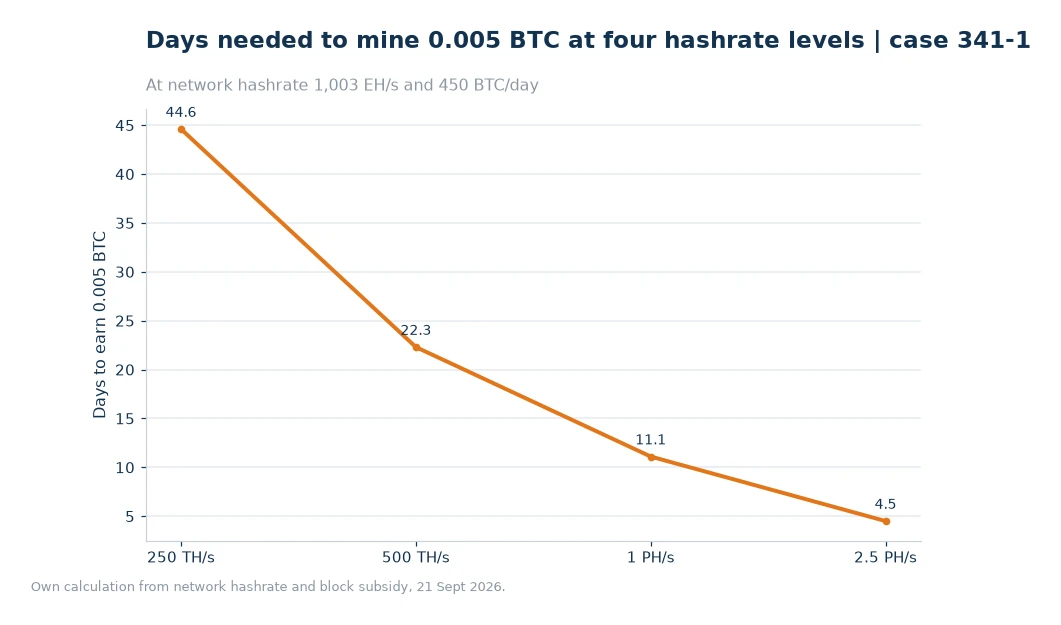
- 0.005 BTC arrives in 44.6 days at 250 TH/s, 22.3 days at 500 TH/s and 4.5 days at 2.5 PH/s.
- At 20 J/TH those four sizes draw 5 kW, 10 kW, 20 kW and 50 kW, so speed is bought with load rather than with patience.
- Merged mining pays LTC and DOGE from one scrypt pass; it adds coins, but it does not raise Bitcoin-side hashrate.
- The chart uses the full 450 BTC daily issuance; the listed 4% on the PPS-settled block reward stretches the shortest wait to about 46.5 days.
Why the reserve is measured in Bitcoin
A savings target is easier to defend in the currency you intend to keep. A miner who earns LTC and DOGE all week still wants one yardstick for the question of whether the month went forward or backward, and for plenty of operators that yardstick is BTC. Once the target reads 0.005 BTC, every choice — which machine, how many hours a day, whether to convert — can be tested against a single figure.
The alternative is a pile of coins in three denominations and no clear answer. Converting everything to fiat at month end produces a number that moves with three exchange rates at once, and comparing that number with last month tells you more about the currency market than about the mining. A Bitcoin target at least holds one rate still, and the arithmetic below depends on that simplification.
There is a second reason to pick the target early: it decides which hardware question you are even asking. If the goal is a dollar amount by a date, the machine is a means of converting electricity into that amount at whatever rate the market offers. If the goal is a quantity of Bitcoin, the price of Bitcoin at the finish line is irrelevant to whether you got there, and that is a much easier promise to keep to yourself.
What merged mining adds to the scrypt side
LTC and DOGE share a hashing algorithm, so one scrypt pass can serve both chains. That is what merged mining means in practice: the pool submits the same work to both networks, and the miner collects rewards from both without a second machine or a second kilowatt. Nothing about it is exotic, and nothing about it is free — the power is already being spent, and the extra coin is the return on that spend.
The added coin has its own moving value. LTC traded at $59.32 when the chain inputs in this article were read on 21 Sept 2026, and DOGE follows a separate chart entirely. Neither rate touches the 44.6-day figure for a 250 TH/s SHA-256 unit, because Bitcoin issuance responds to Bitcoin difficulty alone.
So keep the scrypt rig for spending money and for a second balance if that suits you. Do not treat it as a shortcut to the reserve. It is a separate account with a separate statement, and the moment the two are added together in one cell, the target stops meaning anything precise.
Hashrate sets the calendar, the coin does not
The table runs a single target across four SHA-256 capacities. Daily BTC is the share of 450 BTC that each capacity represents at 1,003 EH/s. The last column applies 20 J/TH, the efficiency assumption used for the power checks later in this piece. The ViaBTC LTC Mining Pool page keeps the LTC and DOGE streams on one dashboard, which is handy for the scrypt ledger and beside the point for this one.
The progression is linear and unforgiving: double the hashrate, halve the days, double the load. No configuration exists in which a larger machine earns the same coins for the same electricity. What changes is how fast the target arrives and how much of the margin the power bill consumes while you wait.
| Capacity | Daily BTC | Days to 0.005 BTC | Draw at 20 J/TH |
|---|---|---|---|
| 250 TH/s | 0.00011216 | 44.6 | 5 kW |
| 500 TH/s | 0.00022432 | 22.3 | 10 kW |
| 1 PH/s | 0.00044865 | 11.1 | 20 kW |
| 2.5 PH/s | 0.00112163 | 4.5 | 50 kW |
Worked example
Take the smallest capacity in the table and follow every step, including the cost side, because the cost side is where a plan usually breaks.
- Daily BTC per TH/s: 450 ÷ 1,003,000,000 = 0.00000044865.
- 250 TH/s contributes 250 × 0.00000044865 = 0.00011216 BTC a day.
- Days to target: 0.005 ÷ 0.00011216 = 44.58, rounded to 44.6.
- Value of the target: 0.005 × 84,692 = $423.46.
- Power at 20 J/TH: 250 × 20 = 5,000 W, or 5 kW, which is 120 kWh a day.
- Daily power cost at $0.06 per kWh: 120 × 0.06 = $7.20, and over 44.6 days that is $321.12.
- Margin over the window: 423.46 − 321.12 = $102.34 before any fee adjustment.
- Fee adjustment: 44.6 ÷ 0.96 = 46.5 days, which adds 1.9 days and about $13.68 of power.
The same route at 2.5 PH/s looks faster and is not cheaper. Ten times the hashrate means 50 kW, or 1,200 kWh a day, which is $72 daily; over 4.5 days that is $324, almost exactly the energy bill of the small machine. Energy per coin barely moves with machine count, which is worth remembering before anyone sells you speed as a saving.
The LTC price is a second dial
Because the LTC leg is priced at $59.32, a move in that rate changes how many dollars the scrypt rig contributes, and therefore how much of the target you can buy rather than mine. The BTC quantity in the chart is untouched by that price; the funding mix is not. A higher LTC price shortens the reserve timeline only if you convert the proceeds.
Two habits follow. Quote the LTC leg in coins and in dollars on the same line, so a price move is visible rather than inferred. Then decide in advance whether that income is spent, converted or stacked, because a rule invented after a price move is a rule invented under pressure.
The habit worth avoiding is the annual forecast. A projection that assumes today's LTC rate for twelve months will be wrong in one direction or the other, and the error then contaminates the reserve target even though the mining itself behaved exactly as planned. Keep the forecast in a column you can overwrite, and keep the recorded numbers in a column you cannot.
The ViaBTC multi-currency wallet keeps both balances in one account, and Auto Conversion can shift one coin into another on a schedule you set rather than on a hunch. For the Bitcoin half of the plan, the Profit Calculator re-runs the daily figure at current difficulty, which is the right moment to check it: before the purchase, not after the invoice.
Frequently asked questions
Does the LTC price change the 44.6-day figure?
No. The 44.6 days come from 250 TH/s against 1,003 EH/s of Bitcoin hashrate and 450 BTC of daily issuance, so the LTC price changes the dollar value of the scrypt rig's output rather than the Bitcoin-side arithmetic.
Is merged mining worth running next to a Bitcoin machine?
It is a separate decision. Merged mining adds LTC and DOGE rewards to scrypt work already under way, while a Bitcoin machine earns only BTC, so compare the two on power cost and on which coin you actually want to hold.
Why does the fee adjustment add almost two days?
The chart uses gross issuance, and the listed 4% on the PPS-settled block reward leaves 96% of that slice; 44.6 divided by 0.96 is 46.5 days, so the reserve arrives about two days later under PPS+.
Fix the target before you fix the hardware
Write 0.005 BTC and its dollar value on one line, the daily BTC of the machine you are considering on the second, and the power cost of running it for that many days on the third. If the third line still leaves a margin you would accept in a mediocre month, the plan holds together. If it does not, a faster machine will not repair it; it will only shorten the stretch during which the margin is thin.
Sources: the ViaBTC fee schedule and pool pages for the listed 4% and the LTC and DOGE merged-mining setup[1]. Chain inputs read 21 Sept 2026: network hashrate 1,003 EH/s, difficulty 132.76 T, subsidy 3.125 BTC per block, 144 blocks a day, BTC $84,692, LTC $59.32. Published 24 Oct 2026. Power figures assume 20 J/TH at $0.06 per kWh and continuous uptime.